
If you own a spectrum or even a sliver of assets — between you and your family — you can probably fund this roof. Banks don't need to see your cash. They need to see something they can feel safe against. You likely have it.
Here is what most building owners do not realize: a bank's decision has less to do with how much cash you have moving through your account right now, and more to do with what you own outright or partially.
Collateral is the language banks speak. Cash flow is one dialect. But equity in property, ownership stakes in businesses, equipment with value, family assets — those are all dialects too.
When a lender sees a portfolio of assets, they see a buffer. They see something to hold if things go sideways. That buffer is what gets deals done — not the number in your checking account on the day you apply.
You have been thinking about this wrong. Not because you are not smart. Because nobody told you the rules.
Explore flexible funding options for commercial roof replacements. Discover programs, rebates, and lenders tailored for Northwest Indiana businesses.
🏢
Any property you own — fully or partially — carries equity a lender can feel safe against
🏠
You don't need to own it free and clear. Partial equity counts
⚙️
Paid-off or nearly paid-off equipment is a real asset with real value
💼
Even a minority stake in a profitable business is something
👨👩👧
Spouses, parents, adult children — a family portfolio combined can unlock what one person cannot
🏗
If you own it, it is already working for you — you may just not have asked it to yet

A building owner came to us convinced he could not qualify. His cash flow had taken a hit. His personal FICO was not where he wanted it. He had already heard discouraging news from a conventional lender.
What nobody had done yet was look at the full picture.
He owns six businesses. Some are doing well. Some are lean. But across that portfolio — the equity, the ownership stakes, the real property — there was more than enough for a lender to feel safe against.
Creative capital does not come from one source. It comes from looking at everything you have already built and asking which piece can move first.
One asset, positioned correctly, unlocked the rest.
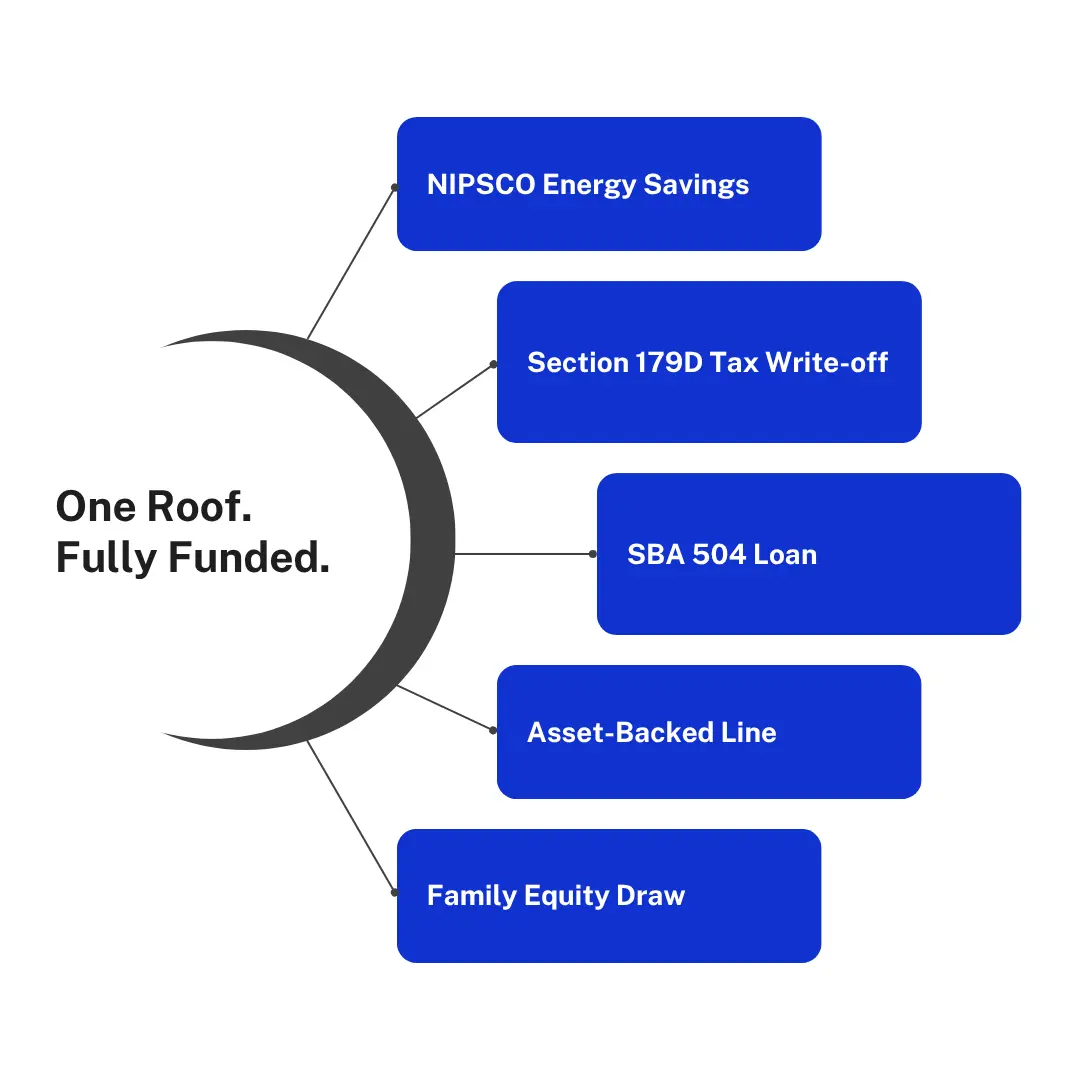
No single funding source has to carry the whole weight. The most creative deals are built in layers — each one contributing what it can, all of them flowing toward the same roof.
Each river is smaller than the total. That is the point. You do not need one massive source. You need several willing ones.

When you bought or leased this building, you used money that was not fully yours yet. You made payments. Over time it became yours. That was not reckless. That was wisdom.
Funding your roof is the same idea — except this time the building starts paying you back immediately. Through a lower energy bill. Through reduced maintenance. Through a roof that stops deteriorating the moment you act.
When you use a loan, an equity draw, an SBA program, or a utility rebate to fund a roof that immediately starts reducing your energy bill — you are not going into debt for something that disappears. You are redirecting money that was already leaving your account every month toward something that stops more money from leaving.
The roof pays you back. Not someday in the abstract. Monthly. On your NIPSCO bill. On your maintenance costs. On the repair bills that never come because you acted before the ceiling did.
The building owner who waits is not saving money. He is spending it slowly and invisibly.
The number on a proposal is visible. The cost of waiting is invisible. That is the only reason waiting ever feels safer.
It isn't.
Tell us about your building and what you own. We will map every funding pathway available to you — NIPSCO savings, government deductions, SBA options, and asset leverage — and show you how they stack together.
No obligation. No pressure. Just a clear picture of what is actually possible.

One conversation. Every pathway. Zero pressure. Just a clear picture of what you can actually do.